Posts

Showing posts with the label Neuro Science

How the Brain Processes Information: The Information Processing Model

Image
Now that we have learnt the different parts of the brain and their function ( here ) and the structure of a brain cell or neuron ( here ), this post is intended to explain a model of how the brain processes new information. By knowing this process, you will be able to know how to manage and optimise your learning. The brain receives information from the environment. The environment around us has stimulus. For example someone talking to us is a stimulus. A book that we read is a stimulus. Our senses such as hearing and sight receive these stimuli from the environment and pass them on to the brain. Different parts of the brain process these information in seconds and also simultaneously. But during this processing some information is lost, some is retained and stored. So what happens between receiving the information from the environment through to losing and/or retaining it. Before I explain each part the information is passed through, scan this image and note the path o...
Learning about learning: The Basics of Neuro-Science -The Brain Cell

Image
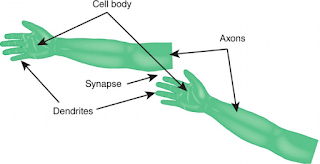
In the first post , I described the different parts of the brain and their different, mostly overlapping, functions. To understand neuro science, one also needs to understand the brain cell or neuron and its structure. In this post I talk about the two types of cells in the brain. Then focusing neurons, I will use a hand and arm analogy to explain the two parts of neuron before going into the technical details of the neuron structure and how information can be lost or retained and passed on. I will tell you a cool fact at the end of the post.   The brain is composed of trillions of cells. These are of two types: the nerve cells or neurons and the glial cells . The brain is mostly of glial cells . Gail cells act as blood-brain barrier and protects the neuron from the blood substance that may disrupt the neural activities. These glial cells hold the neurons together and keep harmful substance out of reach of the neurons . It also regulates the neuron signals. The neu...

Learning about Learning: The Basics of Neuro-Science - The Brain

Image
Neuro science is science of learning. Educational institutions are hugely investing in research on neuro science because this is the new way of improving educational outcomes. So, if you feel you are not so good in learning, try understanding how your brain works; I am pretty sure you will manage and improve your learning capacity. The human brain or nervous system once considered to be only relevant for people studying science subjects is becoming very relevant to every learner. To start understanding what neuro science or science of learning is, one needs to know the basics of the brain. This post is about the brain and its function. It will set a foundation for the future posts on how your brain processes information. Everyone knows that the brain controls all sorts of activities of the body such as: Thinking Problem solving Recognition of faces and objects Receiving and processing sensory memories like touch, pain, sight, taste, hearing, cold/hot Monitoring and contr...